
In this article
What changed
NVIDIA introduced the DGX Spark HPC Developer Kit at SC26. It is a four-node cluster of DGX Spark systems built on the GB10 Grace Blackwell Superchip, with each node cabled directly to its two neighbors in a ring. NVIDIA says the kit is on display at SC26 and available for sale.
What it does
The kit scales from one to four nodes over ConnectX-7 networking, and NVIDIA says there is no network switch to buy or set up. Four nodes give 512GB of combined memory and 20TB of NVMe storage, according to NVIDIA.
NVIDIA says NVFP4 lets researchers run models of up to 700B parameters locally across the four nodes, DeepSeek V4.1 for example. Demonstrated four-system workloads include LAMMPS with Kokkos and NAMD. NVIDIA says the wider DGX Spark community has validated GROMACS, OpenFOAM, WRF and NIM microservices such as OpenFold3 and Boltz-2.
What is verified
Every figure below comes from NVIDIA or from users as relayed by NVIDIA.
- The Hartwig Group at UC Berkeley fit Nemotron 3 Super 120B-A12B on one DGX Spark with NVFP4 quantization for LoRA fine-tuning, running training fits of eight to 24 hours back-to-back.
- Kvantify says one DGX Spark ran its quantum-chemistry circuit simulations at sizes up to 70 qubits and 975 gates, using NVIDIA cuQuantum.
- The Rubin Lab at UC Berkeley's IGI reports results 15x sooner than with 11-hour cluster queue times, predicting bacterial traits with Evo 2.
Running it
The full cluster needs four DGX Spark systems cabled in a ring over ConnectX-7. You can buy DGX Spark products and cables from OEM partners (Acer, ASUS, Dell Technologies, GIGABYTE, H3C, HP, Lenovo, MSI, xFusion) or through NVIDIA Marketplace.
NVIDIA calls its HPC SDK build-and-run playbook for the cluster "coming soon", with no date. It will bring GPU-accelerated C, C++ and Fortran compilers, libraries and MPI tools. NVIDIA also published an open dataset and post-training recipes for adapting Nemotron 3.5 Super VL to life sciences and chemistry on DGX Spark.
What it means for you
NVIDIA aims the kit at researchers and developers who want multi-node workloads at their desk instead of in a shared GPU queue, with unpublished results and proprietary data kept on premises. If that describes your situation, it is worth a look, but treat the vendor and user figures as unverified until someone else measures them.
What the sources don't cover
- NVIDIA's post gives no price for the kit, no date for the HPC SDK playbook, and no licence terms.
- It offers no independent benchmark of the four-node cluster and no multi-node scaling or interconnect throughput figures.
- Power, cooling and per-node specs beyond memory and storage are not stated.
Sources
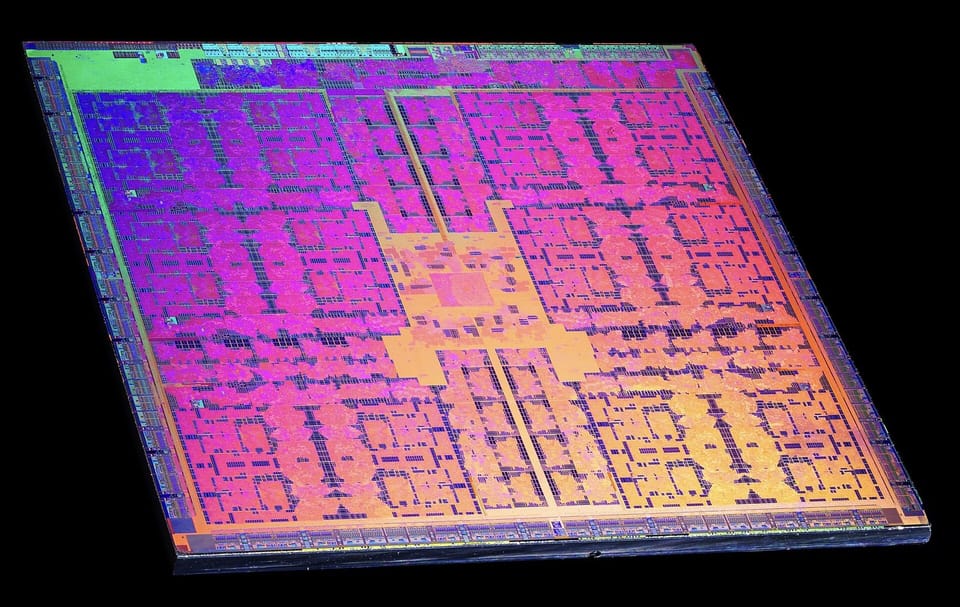
Image: Flickr - Fritzchens Fritz, CC0 1.0, via Wikimedia Commons
This story was produced with AI assistance from the sources listed above and fact-checked against them before publication. Read our editorial methodology and the corrections log. Spotted an error? Email [email protected].





Discussion